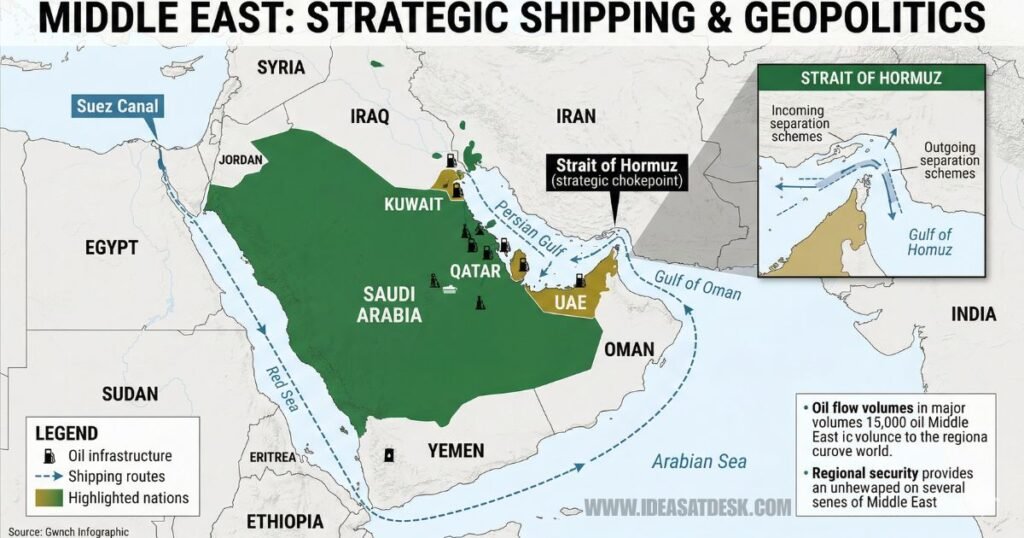
The GCC AI Playbook is playing out in real time, even as missiles fly across the region. When you open the news today, you see conflict, market volatility, and oil headlines. What you don’t see on the front page: the Gulf is still quietly wiring itself as one of the world’s main AI and cloud hubs.
Even in a time of war, GCC governments and Big Tech are not pulling back.
They’re changing what they spend on, shifting from nice-to-have tech projects to infrastructure, security, and sovereign AI.
This is the hidden GCC AI Playbook you need to understand if you live, work, or build in this region.
Table of Contents
The GCC AI Playbook: What’s Still Being Built
Let’s start with the facts on the ground.
Saudi Arabia: Microsoft cloud region is coming
Microsoft confirmed that its Saudi Arabia East datacenter region will be live by Q4 2026. That’s not a pilot. That’s a full Azure region with three availability zones, each with independent power, cooling, and networking infrastructure.
For Saudi banks, telcos, government entities, and large enterprises, this means they can move sensitive workloads to the cloud without sending data abroad. For founders, it means building AI-first products on top of local cloud infrastructure, with no more excuses about latency or compliance.
Brad Smith, Microsoft’s Vice Chair and President, said: “Around the world, governments and institutions are seeking cloud infrastructure that combines innovation with trust, resilience, and respect for national requirements.”
UAE: Sovereign AI with OpenAI and G42
In the UAE, the big signal is the OpenAI-G42 partnership to build a UAE-specific version of ChatGPT. According to Semafor, this isn’t just Arabic UI. It’s a model tuned for local language, UAE regulations, and data that stays on UAE infrastructure.
The UAE also became the first country in the world to enable ChatGPT nationwide under the Stargate UAE initiative, a 1-gigawatt AI computing cluster in Abu Dhabi with 200 megawatts expected to go live in 2026.
In simple words: the UAE wants the best US AI technology, but with Emirati control over data and deployment. This is what many people mean when they say “sovereign AI.”
Qatar: AI compute as a startup incentive
Qatar is taking a different approach. At Web Summit Qatar 2026, the Prime Minister announced that Qatar-based startups will gain dedicated high-performance compute credits to fuel growth.
Through QIA and state-backed platforms, Qatar is offering access to GPU clusters and subsidised compute for selected startups. The message is clear: if you bring your AI startup to Doha, you get the resources to train and scale serious models without flying to California or facing export restrictions elsewhere.
The numbers back this up. Since Web Summit Qatar 2025, 69 startups from the program raised a combined $205 million, with AI and machine learning accounting for $125 million of that total. Qatar also tripled its Fund of Funds program to $3 billion and introduced a 10-year residency visa for founders.
Taken together, Saudi, UAE, and Qatar are not slowing the AI push. They are locking in the next layer of the stack: cloud regions, sovereign-style models, and cheap compute.
How War Changes the GCC AI Playbook
Of course, the war matters. It changes investor psychology and boardroom priorities.
IDC published a “first look” assessment of how the conflict affects global IT spending. Their conclusion is subtle but important:
- Global IT spending growth for 2026 slows slightly from 10% to around 9% in a downside scenario, not a collapse
- In the Middle East and Africa, non-essential tech projects face delays
- But spending on cloud, cybersecurity, and sovereign infrastructure in the Gulf is expected to hold up, or even accelerate
IDC noted that “strategic, regional investment in AI is likely to continue, however, with most of the downside impact focused on business and consumer spending delays.”
In other words, the war is pushing CIOs and ministers to ask: “What do we absolutely need to be safe and operational if things get worse?”
The answers are usually:
- Stronger security and monitoring
- More control over data and infrastructure
- Reliable regional cloud options instead of distant data centres
That’s why the deals you’re seeing are around datacentres, AI infrastructure, and sovereign AI, not random consumer apps. Money isn’t leaving the region. It’s moving into defensive and strategic tech.
What the GCC AI Playbook Means for Workers and Founders
If you live in the GCC, the right question is not “Will AI and tech die because of the war?”
The question is: Which skills and products fit this new spending pattern?
For employees, three categories stand out:
► AI + Data Skills — Not just building models, but applying them safely in finance, energy, logistics, and government. Roles that blend domain knowledge with AI tools will stay in demand as organisations push to do more with less.
► Cloud + Infrastructure Skills — Azure, AWS, G42 cloud, and security on top of them. Saudi’s new region alone will need architects, engineers, and vendors who can design compliant, resilient systems.
► Security + Risk Skills — Identity, monitoring, incident response, compliance, and increasingly, AI-assisted security tools. In a conflict, these budgets are often the last to be cut.
For founders, the lesson is similar:
You want to be on the critical path, not in the “nice to have” bucket.
Ideas that fit this moment:
- Tools that help companies use AI safely (governance, logging, compliance)
- Services that help organisations move to local cloud regions and meet data-residency rules
- Vertical AI products in infrastructure-heavy sectors: ports, airports, utilities, logistics, and healthcare records
If your startup idea depends on customers having “extra budget” and “a calm macro environment,” this might be the wrong year. If your idea reduces risk, saves costs, or uses new sovereign AI and cloud infrastructure, this might be your best window.
THE GCC AI Playbook Takeaway
Headlines will keep talking about missiles and oil. But underneath, GCC countries are still doing something very deliberate:
- Locking in cloud regions (Saudi)
- Building sovereign-style AI models (UAE)
- Turning compute into an incentive to attract founders (Qatar)
In other words: the war changes the mood, but not the direction.
The Gulf is still moving from crude to compute, and AI is now part of its security and economic strategy, not just its innovation story.
If you’re in MENA, the real question for 2026 is simple: Are your skills and projects aligned with this new AI + infrastructure + security playbook, or still living in the pre-war “nice to have” world?
Related: HOW UAE Built Its AI Strategy: Minerals, data Centers and Sovereign ChatGPT